Guide · September 1, 2026 · 4 min read
A penalty ladder the whole team applies the same way
The problem with human moderation is not severity: it is inconsistency. The same behaviour earns a gentle reminder on Tuesday and a ban on Saturday, depending on who is on duty. A warning system exists first and foremost to remove that gap.
Contents
What a warning is really for
Three functions, often conflated.
Telling the person. The obvious function, and the least important: most people know they have crossed a line at the moment they cross it.
Keeping a record. This is the main function. Without a record, the evening moderator has no idea the same person has already been pulled up three times this week, and treats the incident as a first.
Automatically triggering what comes next. This is the function that makes the system consistent: past a threshold, the penalty lands without a human having to decide, and therefore without swings of mood.
A ladder that works
The number of tiers matters less than the spacing between them. Four are enough, and cover nearly everything.
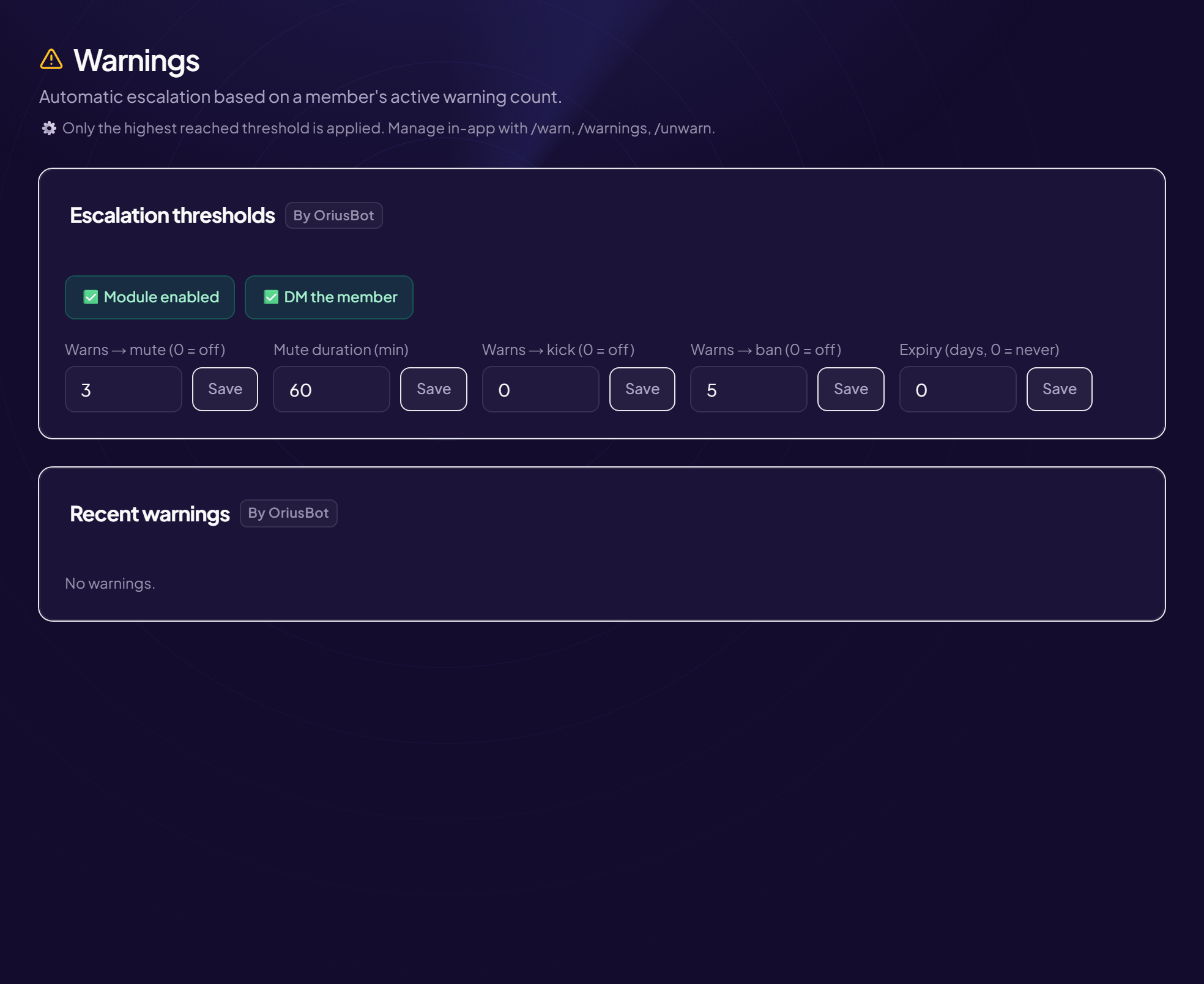
- 1st warning — nothing automatic. The record is enough.
- 3rd — a one-hour timeout. Long enough to interrupt, short enough not to feel like exclusion.
- 5th — a 24 hour timeout. The person comes back the next day, usually calmer.
- 7th — kick or ban, depending on the accumulated severity.
These thresholds are a starting point. What matters is that they are written down and identical for everyone.
The memory has to expire
This is the most frequently forgotten setting, and the one that decides whether the system is still fair a year later. Without expiry, a member warned twice eight months ago reaches their third warning — and a timeout — over an unrelated trifle.
A memory of 60 to 90 days suits most servers. Beyond that, warnings stay in the record but no longer count towards escalation. The trace is kept without becoming a permanent criminal record.
Always write the reason
A warning with no reason is unusable three weeks later: neither the next moderator, nor the person concerned, nor you will know what it was about. Make the reason mandatory, however short.
A good habit is to write the reason as though the person being penalised were going to read it — because they will, if they dispute it. “Repeated insults towards a member despite a reminder” is usable; “him again” is not.
Telling the person, and how
A warning delivered by private message avoids public humiliation and markedly reduces aggressive reactions. Two limits: closed private messages block delivery, and an invisible warning deters nobody else.
The usual compromise: a private notification every time, plus a brief public mention when the incident happened in public. The channel sees that something was done, without a display.
What automation should and should not do
Automatic escalation handles the repetitive cases: spam, insults, advertising. It must not handle serious cases. Illegal content, established harassment or a threat does not go through a counter — they justify an immediate decision, taken by a human, without waiting for the third warning.
Conversely, a moderator should never have to “add two warnings at once” to force a penalty. If the need arises, the ladder is badly tuned: fix the thresholds rather than work around them.
Carrying over an existing record
When changing bots, people often want to keep the warnings already given. One precaution is required: importing a record mechanically triggers the escalation thresholds, and can time out a dozen members at once over old business.
The import must therefore be silent: warnings enter the record without triggering anything. It is also the moment to check what you are importing — a record inherited from a former team often contains penalties nobody would stand behind today.
Frequently asked questions
Should it be possible to remove a warning?
Yes. Mistakes happen, and a system with no way back pushes moderators to record nothing “just in case”. The removal must itself leave a trace.
Who can see a member's record?
The moderation team, and the person concerned for their own. A record everybody can read turns moderation into a noticeboard.
Should warnings have different severities?
It is tempting, and it complicates things a great deal. On most servers a single warning with a written reason is enough; the severity is readable in the reason.
What about a member who comes back after a ban?
Treat the evasion itself as a serious matter, independently of the original reason. Otherwise the ban means nothing.
Read next : Auto-moderation, Logging, Support tickets.