Guide · September 1, 2026 · 4 min read
Restarting a server that has gone quiet
Silence on a server is not a lack of interest: it is a problem of getting started. Nobody wants to be the one writing in an empty channel. The mechanisms below provide that start every day, without the team having to think about it.
Contents
Why a server goes quiet
A channel with no message for twelve hours has a measurable deterrent effect: writing means exposing yourself alone. Everyone waits for somebody else to start, and nobody starts. It is not disinterest in the community, it is hesitation in front of an empty channel.
All automatic activity serves that purpose, and nothing else: guaranteeing there is always a recent message to reply to. What the bot posts matters less than the fact that it posts something at a fixed time.
The question of the day
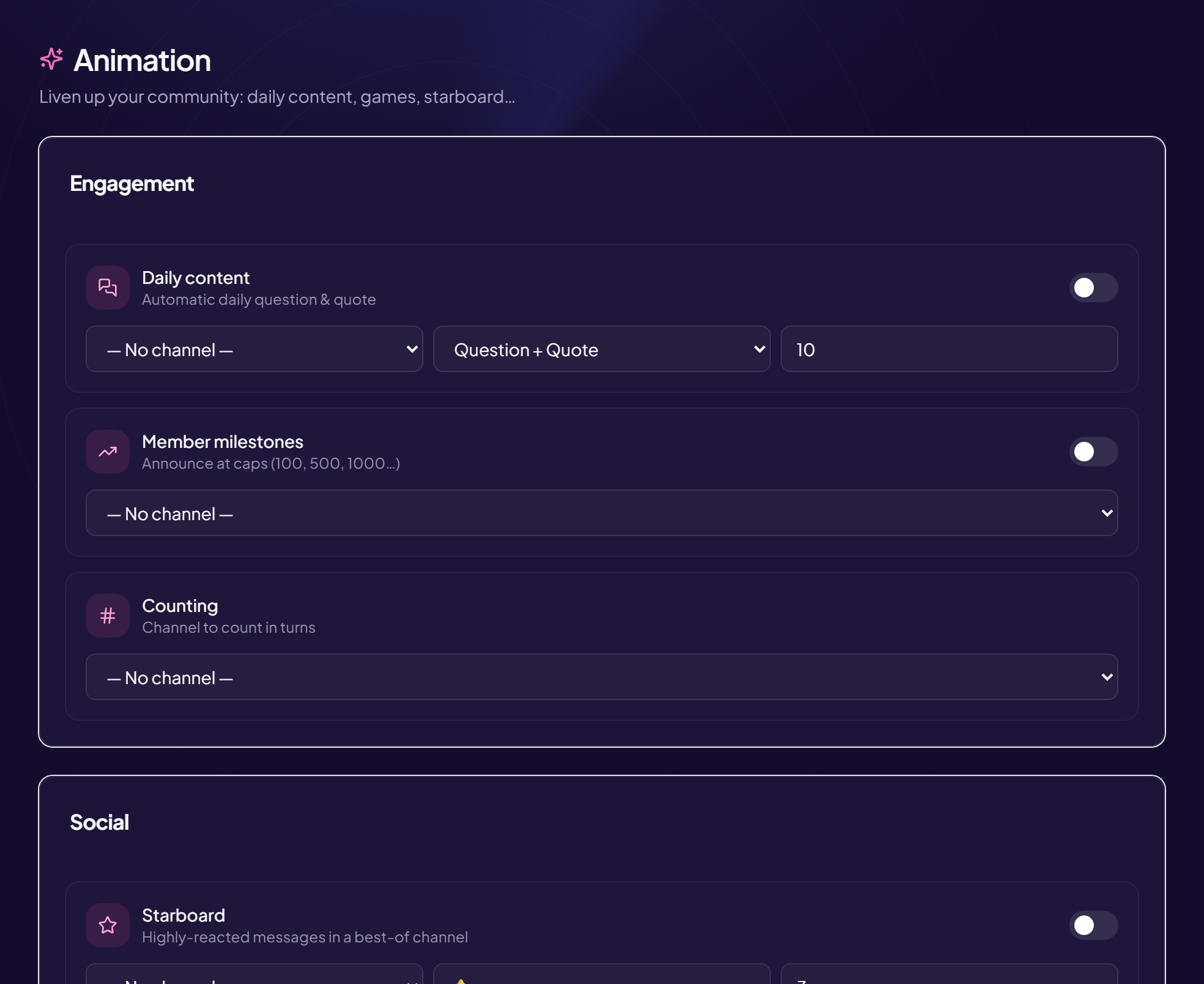
This is the most cost-effective mechanism. One message a day, at a fixed time, with an open question everybody can answer in a sentence. Three rules make it work.
- Open, but not vague. “What's the last thing you learned by accident?” works. “How are you?” does not — the answer fits in one word and closes the conversation.
- With no right answer. As soon as a question has a correct answer, only those who know it reply.
- At a fixed time. Regulars end up watching for it, and that is exactly the effect you want.
A daily quote or anecdote plays the same role and takes less preparation, but generates fewer replies: people read it, they do not latch on to it. Both can coexist at different times.
The counting channel
The idea is absurd and works remarkably well: a channel where members write the numbers in sequence, one per message, with nobody allowed to write twice in a row. A mistake sends it back to zero.
What keeps that channel alive is the collective record. It turns an individual activity into a shared goal, and it produces conversations in the other channels — about who broke the streak, about the strategy for going further. Plan to display the previous record when the streak falls: without it, failure has no flavour.
A weekly rhythm that holds
- Every day — the question of the day, at a fixed time.
- Once a week — a poll on a real server decision.
- Once a month — an event announced in advance: game night, contest, a leaderboard reset.
- Continuously — counting, best-of board, mini-games.
The best-of board
A message that gets a certain number of reactions is copied into a dedicated channel. That serves two functions: keeping a record of the good moments, and showing newcomers what the community looks like when it is going well.
The reaction threshold is the only setting that matters. Too low and the channel fills with anything and everything; too high and it stays empty and nobody looks at it. A useful benchmark: the threshold should match what a very good message gets once or twice a week, not several times a day.
Member milestones
Announcing the 100th, 500th or 1000th member gives the server a rhythm and reminds those who have been around a long time how far it has come. A permanent counter in a voice channel or a category does the same job continuously.
One reservation: these announcements highlight growth. If the server is flat or losing members, they become counterproductive. Better to switch them off than to let them repeat the same thing every week.
What does not work
@everyone mentions for activity. They work once, then members mute the server's notifications — including for your important announcements.
Too many automatic messages. Beyond two or three a day, the server feels like it is being run by a robot in a deserted room, which is worse than silence.
Rewards with no audience. Giving currency for answering the question of the day attracts empty replies. What motivates people to answer is that somebody reads.
Frequently asked questions
What time should the question of the day be posted?
Early evening for most communities: that is when the most people are around. Set it against the server's time zone, not UTC.
Does the question of the day need a dedicated channel?
No: in the general channel it restarts the conversation. In a dedicated channel it is read by those who already go there — that is, by those who were talking anyway.
How long before you see an effect?
Two to three weeks. In the first few days only the regulars reply; the effect comes when the question becomes an appointment others look forward to.
And if nobody answers?
It is almost always a problem with the question, not the audience. Concrete, personal questions get answers; abstract ones never do.
Read next : XP and levels, Mini-games, Suggestions and polls.