Guide · September 1, 2026 · 3 min read
A server that speaks several languages
Hosting several languages on one server raises three distinct questions: which language the bot speaks, how to organise the channels, and how to moderate messages you cannot read. They do not have the same answer.
Contents
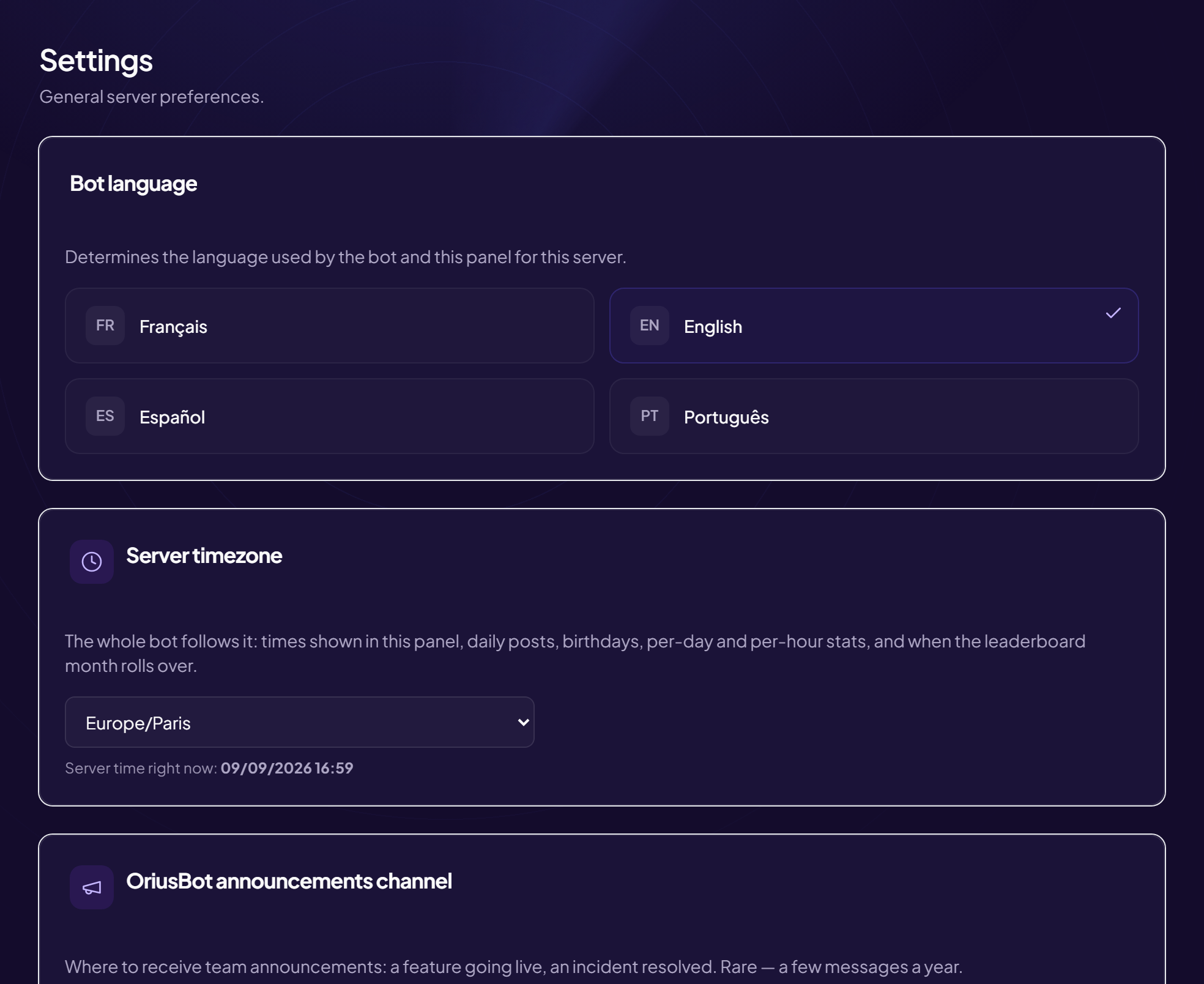
The bot's language
It is set per server, not per member: public messages — welcome, announcements, level-ups — are read by everyone, and cannot be written in four languages at once.
The choice is therefore made on the community's main language, the one of the rules and the announcements. Members who speak another language will rely on the dedicated channels and, if you enable it, on translation.
One thing to check before committing to a language: is it genuinely translated everywhere? A bot that advertises four languages and switches to English the moment you enter a configuration wizard is more confusing than an openly monolingual one.
Separate channels, or a shared channel
Both arrangements work, and they produce different communities.
Channels per language give natural conversations: everyone writes effortlessly, and moderation splits by language. The drawback is structural — the server becomes two communities side by side, meeting only in the announcements.
A shared channel with translation keeps everybody together. Exchanges are slower and sometimes approximate, but the members genuinely talk to each other. It is the right choice when the server's subject matters more than the language.
A rule that settles it
Below two or three hundred members, a shared channel with translation: splitting would produce two empty channels. Above that, channels per language, because there are enough people in each for the conversation to live on its own.
Automatic translation, and its limits
It helps, provided you know what it does badly. It fails on irony, on slang, and on very short messages — precisely what a chat is made of.
Two precautions are worth taking. Show the translation next to the original message, never in its place: somebody who understands both languages must be able to correct a misreading. And do not translate every message automatically: translation on demand, on the message you do not understand, produces far less noise.
Moderating a language you do not speak
This is the real problem of a multilingual server, and it does not get solved technically.
An automatic banned-word filter only covers the languages it was written for. Multilingual toxicity detection helps, but it does not make up for context: an affectionate insult between friends and an attack look very much alike, and even more so in a language you do not speak.
The only solid answer is human: at least one moderator per open language. Opening a channel in a language nobody on the team reads amounts to creating an unmoderated space, no matter how good the tools are.
Practical corollary: only open a language when you have somebody to hold it. Three well-covered languages beat six advertised ones.
What should be translated first
- The rules. Penalising somebody over a text they cannot read is indefensible.
- The welcome message. It is the first minute; it decides the rest.
- The bot's refusal messages. A refusal that is not understood looks like a fault.
- Important announcements. Two versions in the same message are enough: no need for a channel per language.
The rest — command descriptions, help texts — can stay in the main language without much harm.
Frequently asked questions
Can the bot speak a different language per member?
For private replies, that is conceivable. For public messages, no: they are read by everyone, and a decision has to be made.
Are language roles needed?
Useful with separate channels: the role gives access to the matching channels and lets you mention a single community for a targeted announcement.
Does translation consume a lot?
Translating every message in an active channel is expensive and rarely useful. Translation on demand costs almost nothing.
How should channel names be handled?
A clear language prefix, and short names. A channel named in a language half the server cannot read becomes invisible to that half.
Read next : The web panel, Auto-moderation, Server rules.