Guide · September 1, 2026 · 4 min read
A server economy that does not collapse
Almost every Discord server economy follows the same curve: great fun for two weeks, dead after a month. The cause is always the same — money comes in faster than it goes out. This guide explains how to close the circuit.
Contents
The problem: nobody spends
A daily command gives 500 coins. A work command gives 200 every hour. Within two weeks a regular member has tens of thousands of coins and nothing left to do with them. The rich list freezes, newcomers realise they will never catch anyone, and the feature stops being used.
It is not a problem of tuning the earnings: it is a problem of outflows. An economy holds when money has regular reasons to disappear. In other words, you have to think as much about what costs as about what pays.
Wallet and bank, two different pockets
Splitting the money in two changes everything else about the system. The wallet is what you carry: available immediately, and vulnerable — it is what you lose when robbed or when betting. The bank is safe, but it has a ceiling.
That ceiling is the keystone. It creates a permanent decision: keep your money safe but limited, or leave it out to play with it and accept the risk. Without a ceiling, everybody banks everything and robbery ceases to exist.
The four ways money comes in
- Daily — a fixed amount, once a day. Rewards regularity.
- Work — smaller, several times a day, with a break in between.
- Robbery — takes from another player's wallet, with a chance of failure and a fine.
- Heist — rare, very lucrative, very risky. The event of the month, not the routine.
These earnings are capped over the day: without a cap, somebody available sixteen hours a day earns sixteen times more than somebody who drops in during the evening.
The outflows: shop, vault, charges
Three families of spending, to be put in place in this order.
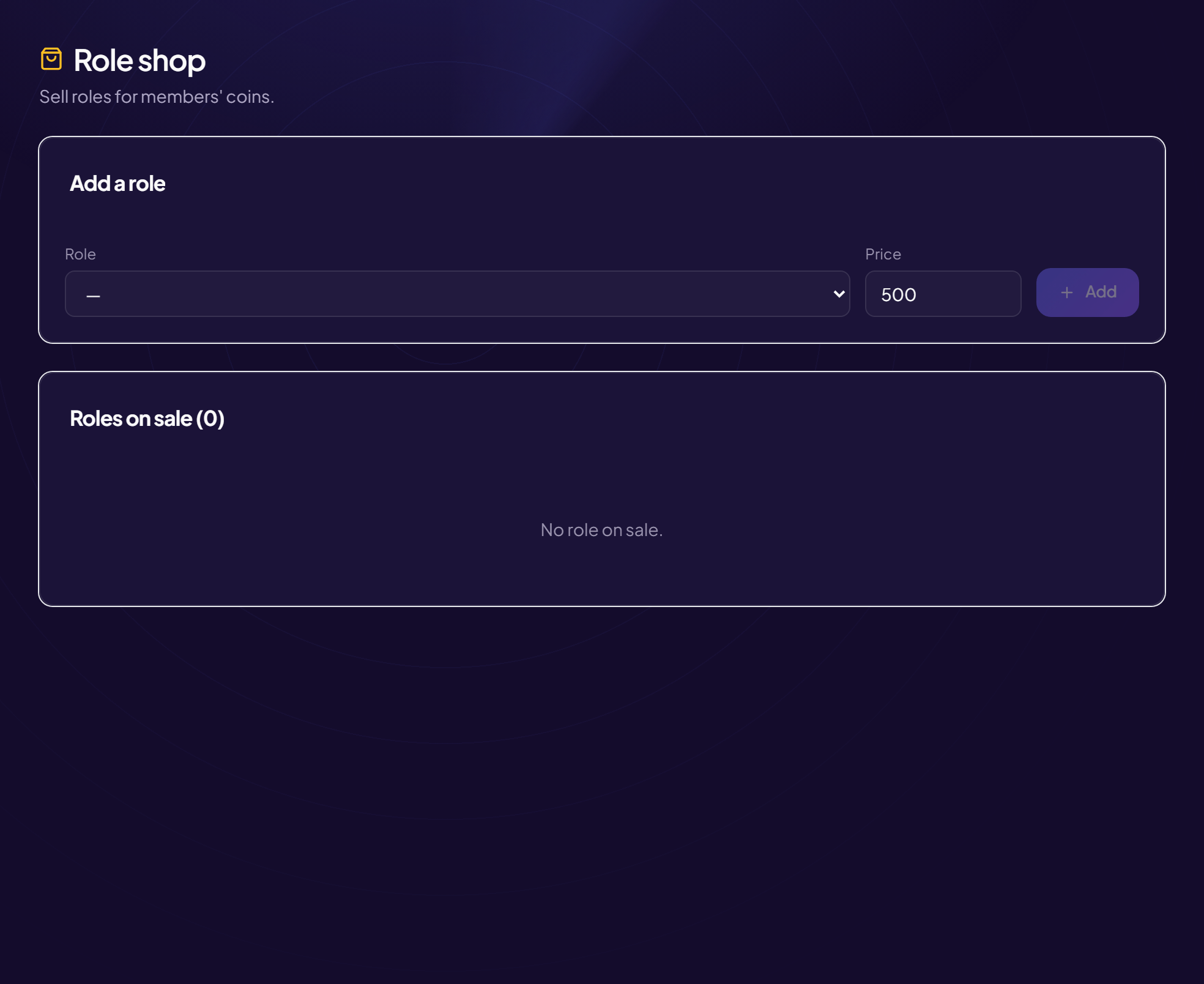
The server shop sells whatever you decide: a colour role, access to a channel, the right to choose the question of the day. It is the simplest outflow to set up, and the only one that gives money a visible social use.
The global store sells durable goods — a vehicle, a home. They do nothing mechanically, and that is precisely the point: they are bottomless pits absorbing large fortunes, and an object of pride displayed on the profile.
Daily charges are the most effective tool, and the trickiest to tune. Every day, a small fraction of the estate is levied; above a certain wealth threshold, an additional levy applies. An inactive person watches their fortune melt slowly, which reopens the leaderboard.
Credit, to be handled with care
Lending money to members creates an interesting dynamic: you borrow to buy sooner, then you repay. Two conditions keep it from going wrong.
- An amount tied to standing. Somebody who has just arrived does not borrow as much as an established member. The maximum must depend on what the person has already repaid.
- A consequence for not repaying. Without one, borrowing is a gift. Bankruptcy — estate reset to zero, goods seized, standing downgraded — is not a moral punishment: it is what gives repaying its meaning.
Bets between members
A betting system works if it requires no trusted third party. Two members stake on the outcome of a game; the bot holds the stakes and pays the winner automatically. Nobody has to trust anybody, and there is nothing to arbitrate in a dispute — the result is the one the bot observed.
The casino, by contrast, needs a firm limit: a maximum stake and a number of games per day. Without that it becomes the server's only economic activity, and destroys the whole balance built elsewhere.
Starting without switching everything on
A complete economy deployed in one go is unmanageable: nobody understands the rules, and you have no idea which setting is at fault when something goes wrong. A rollout in three stages works better.
- Week 1 — daily earnings, work, and a shop with three items.
- Week 2 — bank, ceiling, robbery. Risk appears.
- Later — charges, credit, heists, durable goods. Once the currency is circulating.
Frequently asked questions
How much should the daily give?
The absolute value does not matter: only the ratio to the shop's prices counts. A token item should cost two or three days, a prestigious one several weeks.
Should gifts between members be allowed?
Yes: it is what makes the currency social rather than solitary. With one reservation — gifts are sometimes used to get around the bank ceiling by storing money with a friend. A daily gift cap settles that.
How do you restart an economy that has already died?
By adding outflows, not by reducing earnings: lowering earnings punishes newcomers without touching the fortunes already built. A general reset stays possible, but it is prepared and announced.
Is the economy shared across servers?
No. Each server has its own currency, prices and leaderboard: a fortune built elsewhere is worth nothing on yours.
Read next : XP and levels, Mini-games, Day-to-day activity.